Optimising irrigation management for more drought-resilient orchards
Funded through the Australian Government’s Future Drought Fund, the $7.8 million, five-year Tree survival signatures for horticulture industry resilience to drought project aims to identify critical water stress thresholds in almond, pear and nectarine trees before long-term productivity is impacted. Researchers will establish ‘tree survival signatures’ – a response function that describes the relationship between water status and subsequent season productivity in fruit and nut crops.
By understanding these indicators, the project will develop practical irrigation decision-support tools and management guidelines to help growers:
- Better prioritise water resources during drought
- Be aware and make more informed irrigation decisions
- Protect orchard long-term health and productivity
- Improve tree recovery following drought
- Build long-term orchard resilience.
Developing practical tools and management guidelines
The Victoria Drought Resilience Adoption & Innovation Hub (Vic Hub) brings together a consortium of project partners comprising of the University of Melbourne, Agriculture Victoria, Federation University and the Mallee Regional Innovation Centre to undertake the research and drive adoption of project outcomes across Victoria’s horticulture industry.
Over four growing seasons, the project will investigate how almond, pear and nectarine trees respond physiologically to water stress during drought. The research will also examine how de-fruiting influences tree survival, recovery and productivity, generating evidence needed to develop practical irrigation decision-support tools and management guidelines for growers.
Using an Airborne Subnanometer Hyperspectral Imaging Sensor, Australia’s only hyperspectral sensor of its kind, researchers from the University of Melbourne’s Hyperspectral and Thermal Remote Sensing Laboratory (HyperSens) will use aerial hyperspectral and thermal remote sensing, and in situ sensors to monitor tree water status across the orchard field experiments, providing detailed insights into tree water stress that underpin the development of tree survival signatures.
These aerial observations will be combined with robust field trials led by Agriculture Victoria at its Mildura and Tatura SmartFarms. Researchers will monitor a diverse range of orchard systems using dendrometers, micro-tensiometers, gauges and thermal imaging to measure the effects of severe irrigation deficits, rootstocks, de-branching and crop removal on water status and long-term yield. Demonstrations in collaboration with industry will showcase practical drought management strategies relevant to regional growing conditions to support on-farm adoption.
Ensuing the project is practical for growers, Federation University's Centre for eResearch and Digital Innovation (CeDRI) will evaluate the decision-support tools to ensure they are accessible, practical and suitable for adoption by industry. Research findings will also be combined with grower knowledge and industry expertise provided by the Almond Board of Australia, Apple and Pear Australia Limited, Summerfruit Australia Limited, Fruit Growers Victoria and SuniTAFE, helping to ensure the research remains relevant to industry needs and priorities.
Together, this integrated approach will deliver a comprehensive study of drought resilience in perennial horticulture, equipping growers with the knowledge and practical tools to improve water management, protect orchard productivity and strengthen resilience to future droughts.
Project updates
Video: Tree Survival Signatures for Horticulture Industry Resilience to Drought - introduction and update from Dr Ian Goodwin, Agriculture Victoria (September 2026)
Dr Ian Goodwin (Research Leader Horticulture production Sciences - Agriculture Victoria), based at the Tatura SmartFarm, talks about the the Tree Survival Signatures for Horticulture Industry Resilience to Drought project and provides an update (September 2026)
Video transcript
We started the project running very quickly. So in other words, in the first year of the project we set up a whole series of irrigation experiments on pear, nectarine and almond. The almond was done at Mildura, at the Mildura SmartFarm. Here at Tatura, at the Tatura Smart Farm, we did it on pears and nectarines.
So we set up some irrigation treatments. Within those irrigation treatments, we also looked at removing the fruit and we also removed some of the branches on the trees to look at what impact that might be in terms of the development of water stress. So those irrigation treatments were basically a rain fed treatment, a control where we're matching crop water requirements through the irrigation system, and then a third treatment where we had a stress threshold. In other words, we withheld irrigation until the trees got to a certain level of stress, and then we reapplied the irrigation.
How was the research conducted?
We used basically three instruments. One was what's called a micro-tensiometer and it's a sensor that sticks in the trunk of a tree, if you like, and that can monitor the, what we call the water potential in the tree, which is a measure of its fundamental plant physiology as a measure of the stress on the tree. The second sensor was one that's external. We don't have to drill a hole and stick the sensor in. It sits on the trunk of the tree, and it measures the expansion and shrinkage in the trunk. So, during a day when leaves are on the trees, not like what they look like at the moment, when they've got leaves on them, they shrink during the daytime and then swell at night. So, the trunk is just, all of the branches, everything is doing, going through that process. So, how much they shrink is a function of how stressed those trees are. So, if they're water stressed, then they'll shrink more, and if they get very stressed, they shrink, shrink more and more, and then finally they don't recover in the evening as well. So this is an instrument that we actually think is giving us a really... we think it's a very useful tool to be able to, for growers to be able to use to give a measure of how stressed their trees are through a sensor technology. The third sensors we're using are airborne. So, with our partners at the University of Melbourne, they have a team that does a lot of work on remote sensing through cameras and hyperspectral cameras that are mounted on an aeroplane, and they can fly over crops and monitor how stressed those crops actually are. So, they obviously were doing that above the treatments we've set up on the ground to monitor from the air how stressed those crops actually are. So, they did several flyovers. Of course, it's not a continuous monitoring system like the stuff on the trunks. This is... You, you have to have a flight plan, you have to go over it, and you can only do so many flights per season. But again, it's potentially, once we go through the process of evaluating, it's potentially a tool that growers can't do it, but, you know, potentially they can access services that can provide that sort of data.
What has surprised you in the research?
Extreme treatment is rain fed, so no irrigation in our environment here at Tatura, and also in the environment at Mildura. What really surprised us was that those trees didn't get as stressed as perhaps we thought they would be. You know, basically the trees were survived. Of course, the crop that was on them was of no value whatsoever. So, you know, it was quite surprising that particularly in the pears and the almonds, how well those trees coped with no irrigation whatsoever. So, the real question now becomes is, in this season now, in other words, in the subsequent season to when we applied those treatments, how do those trees recover in terms of their productivity?
What are the next steps for the project?
This coming season, we'll monitor how those trees that we applied the treatments to last year, how they recover. You know, what is their productivity going to be like this year and in subsequent years? But we've set up additional experiments on other trees to repeat a similar suite of measurements, and we might actually even look at two years of rain fed versus full irrigation, for example. So, we've got some initial experimental data. We need to measure the recovery of those trees. We've set up additional treatments to go through and, it's not completely repeat, but do something to similar as we did in the first year. And of course, you know, the tools that we've identified in that first year, we'll be really focusing in on the trunk shrinkages and expansion tools, for example, and putting more of those sensors out to monitor what's going on.
Maximising tree survival, productivity and faster orchard recovery
Periods of extreme water scarcity present significant challenges for Australia's $18.4 billion horticulture industry, requiring growers to balance limited water resources with the need to protect long-term orchard productivity.
During the Millennium Drought (1996-2010), Victoria’s annual catchment streamflow declined by 20-40%, resulting in reduced water allocations and escalating temporary water prices. These conditions forced many orchardists to make difficult decisions about where limited water resources could deliver the greatest return, while also weighing up the financial burden of purchasing temporary water.
As climate variability and future droughts continue to test the resilience of irrigated perennial tree crops, consultation with growers and water resource managers has identified the need for clear guidance and practical tools to inform water management decisions that maximise tree survival, minimise productivity losses and support faster orchard recovery.
Victoria is the largest producer of fruit and nuts in Australia, accounting for 33% of national production in 2021/22. The state’s diverse horticulture sector includes pome fruit, stone fruit, citrus and nut industries, making it well suited to investigating the impacts of water stress on perennial tree crops. The project focuses on stone fruit, pears and almonds, which are among Victoria’s major irrigated perennial horticulture commodities.
Resources
Factsheet: Tree survival signatures for horticulture industry resilience to drought
Download content accessible Word version: Tree survival signatures for horticulture industry resilience to drought
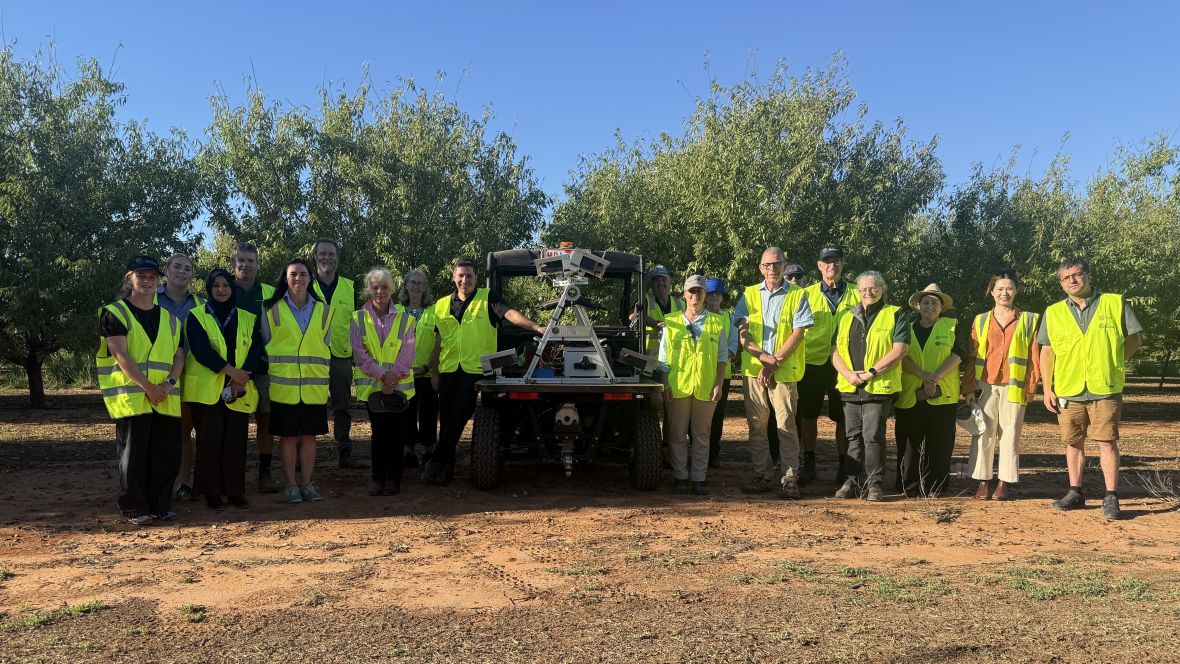
Project partners at Agriculture Victoria’s Mildura SmartFarm (March 2026) with a Green Atlas Cartographer, mapping tree performance of the orchard.
Acknowledgement
The 'Tree survival signatures for horticulture industry resilience to drought' project is funded through the the Australian Government’s Future Drought Fund, led by University of Melbourne in partnership with the Victoria Drought Resilience Adoption & Innovation Hub (Vic Hub), Agriculture Victoria, Federation University and the Mallee Regional Innovation Centre to undertake the research and drive adoption of project outcomes across Victoria’s horticulture industry.
