Prepare your horticultural business for bushfire, respond safely on high-risk days and plan for recovery after a fire.
The Horticulture Bushfire Toolkit brings together practical checklists, planning templates, emergency contacts and recovery resources for horticultural businesses.
On this page
Choose the format that best meets your needs:
- Horticulture Bushfire Toolkit — PDF (digital version 6.67MB)
- Horticulture Bushfire Toolkit — accessible Word version (coming soon)
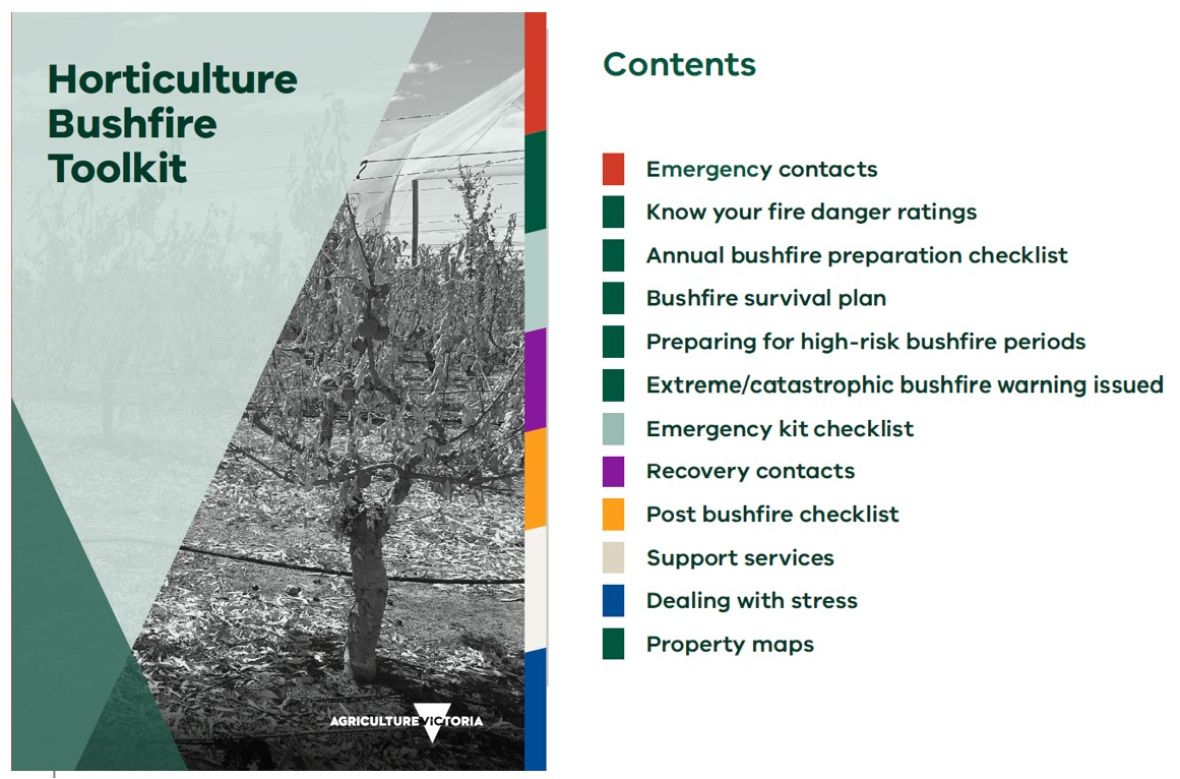 Horticulture Bushfire Toolkit for Victoria: Front page and contents list
The characteristics of every farm and farming business are different, and each farm requires a unique approach to fire preparedness. Developing a fire plan and undertaking the tasks identified within it, can assist you to be better prepared and recover faster, should your property be affected by fire. Your fire plan should reflect your property, people, crops, equipment, water supplies, access routes and local risks. Prepare and review your plan before each fire season so everyone understands what to do.
Emergency contact list
An emergency contact list is an essential part of a fire plan. It should list the phone numbers of emergency services, state and local government contacts, local hospital, veterinary clinic, family members, employees, neighbours and other key contacts. An emergency contact list can be found in the Horticulture Bushfire Toolkit.
Annual bushfire preparation checklist
Your fire preparedness plan should be reviewed on an annual basis, ideally before the start of the fire season. The review should involve all family members and employees.
The discussion should clearly identify individual responsibilities, their roles, equipment and what to do during periods of high fire danger. This review may also be a good time to undertake a refresher on the use of pumps and other firefighting equipment.
You can use the resources from the Horticulture Bushfire Toolkit for your bushfire preparedness checklist which includes:
- annual bushfire preparation checklist covering personal safety and skills, crops and sheds, communications and business continuity
- bushfire survival plan
- preparing for high-risk bushfire periods
- extreme/catastrophic bushfire warning issued (checklist)
- emergency kit checklist
Create a farm map
A farm map can be a useful tool in the development of a fire plan. It can clearly identify critical assets, water sources, assembly/evacuation and exit points and stock refuge areas.
Consider making multiple copies of the map to share with family and employees and place copies in visible and easily accessed areas. The farm map can be hand drawn, an existing aerial photo or developed using custom made mapping software.
You can use the resources from the Horticulture Bushfire Toolkit to create your farm map.
Planning for high-risk days
Your fire plan should include an action plan based on bushfire warnings. The action plan should include agreed trigger points for various actions and responses; when to leave, who will leave, where will they go? You may need to stay for several days so this needs to be taken into consideration.
The Horticulture Bushfire Toolkit contains a Bushfire Survival Plan that should be filled out before the bushfire season and revised annually.
- Bushfire survival plan: Consider developing information about leaving or staying when developing your bushfire plan.
Useful CFA templates for high-risk days
There are several CFA templates that guide you through developing a plan for high-risk days. The bushfire survival planning templates – leaving early and defending your property can be found in the publications section of the CFA website.
If planning to defend your property it is highly recommended that you have a discussion about it with your local CFA fire brigade. CFA will be able to offer advice about how to reduce the risks of planning to defend your property.
For more information visit the CFA website.
After the fire
It is important to consider the dangers associated with returning to a fire affected property. These dangers can include fallen powerlines, dangerous trees, burning stump holes and ground contaminated with asbestos or chemical residues.
A careful and methodical assessment should be carried out to make the farm as safe as possible before recovery work commences.
Your fire plan should include a section on recovery. How will you look after yourself, your family, employees and neighbours? What are the priority actions that need to be taken once the fire has been extinguished?
You can use the resources from the Horticulture Bushfire Toolkit for bushfire recovery. This includes:
- recovery contacts
- post bushfire checklist, including information on clean up an assessment of fields
- support services, includes financial support and non-financial support
- dealing with stress
Bushfire impact assessment
Record fire impacts
You can use the Horticulture Bushfire Toolkit’s Post Bushfire Checklist to assess and record potential risks and impacts.
Agriculture Victoria also provides a simple fire impact assessment form (for animals and crop industries) to help you document any losses and consider the priority steps you need to action after a fire event.
Use the fire impact assessment form to record losses and identify priority actions for animal and crop industries:
Agriculture Victoria resources
Other emergency and recovery resources
Fire preparedness videos
Contact
For information about fire preparedness or recovery, email recovery@agriculture.vic.gov.au or call Agriculture Victoria on 136 186.
Acknowledgments
The Victorian Farm Business Resilience program is jointly funded by the Victorian Government and the Australian Government's Future Drought Fund.
We acknowledge the Queensland Fruit and Vegetable Growers association (Growcom) for their assistance in supporting the development of this bushfire toolkit.
Disclaimer:
This publication may be of assistance to you but the State of Victoria and its employees do not guarantee that the publication is without flaw of any kind or is wholly appropriate for your particular purposes and therefore disclaims all liability for any error, loss or other consequence which may arise from you relying on any information in this publication.